
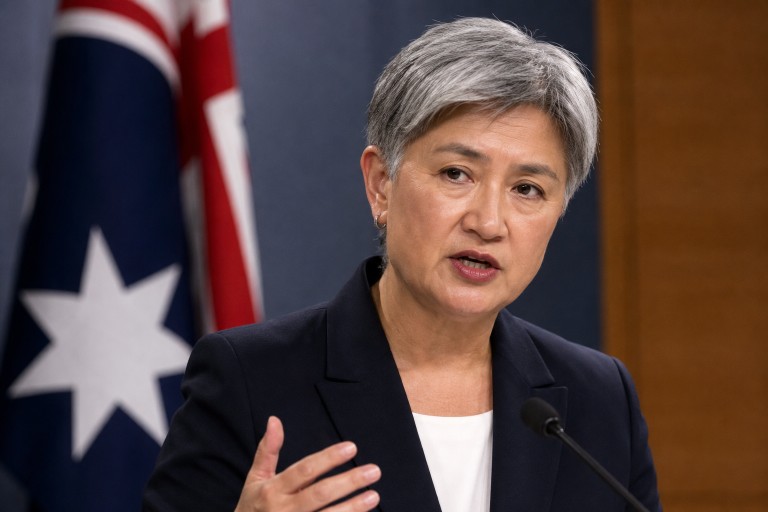
Australia and its regional partners are taking a firm stance against China’s recent “provocative” actions, with Foreign Minister Penny Wong poised to assert that they will not be intimidated by Beijing’s maneuvers. Her upcoming remarks at the ASEAN Foreign Ministers’ Meeting in the Philippines highlight growing unease over China’s military expansion and activities in the Indo-Pacific region.
During the meeting, Wong is expected to critique China’s recent test of a nuclear-capable submarine-launched missile in the South China Sea. She is likely to point out the lack of transparency and advance notification surrounding this test, which has raised alarms about regional stability. Additionally, Wong will address concerns over China’s swift military modernization and its expanding nuclear capabilities, emphasizing the need for greater openness to ensure peace in the region.
The tensions in the South China Sea have been further exacerbated by a recent incident where the Philippines accused the China Coast Guard of using force against one of its sailors. Australia has expressed its apprehensions regarding actions that jeopardize the safety of vessels from countries such as the Philippines, Vietnam, Malaysia, and Indonesia. This ongoing situation underscores the need for international cooperation to address security challenges.
Beyond regional security, Wong is also expected to warn against potential disruptions to shipping through the Strait of Hormuz. She will highlight the critical nature of this maritime route, stressing that instability there could severely impact energy supplies, trade, and food security across the Indo-Pacific. The smooth operation of international sea lanes is crucial for countries relying on maritime trade for essential commodities like fuel and fertilizer.
In response to these rising geopolitical tensions, Australia remains committed to collaborating with ASEAN partners to bolster regional stability, secure supply chains, and enhance economic resilience. This commitment reflects a broader strategy to navigate the complex challenges facing the Indo-Pacific region amid the evolving geopolitical landscape.