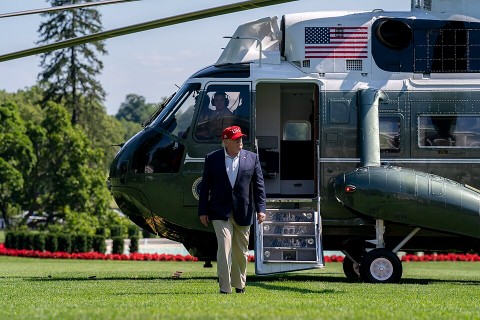
Donald Trump has indicated his intent to communicate directly with Taiwan’s President Lai Ching-te, a move that could significantly impact U.S.-China relations. “I’ll speak to him,” Trump told reporters at Joint Base Andrews in Maryland, referring to the Taiwanese leader. This marks a potential shift in diplomatic interactions, as direct communication between U.S. and Taiwanese presidents has not occurred since 1979, when Washington recognized Beijing over Taipei. Trump’s comments come after a meeting with China’s President Xi Jinping, and he has reiterated his intention to speak with Lai, countering any notion that his first mention was accidental.
Taiwan’s foreign ministry expressed that President Lai would be pleased to engage in conversation with the U.S. leader. Despite this potential dialogue, the Trump administration has conveyed mixed messages regarding its stance on Taiwan. While Trump has approved more arms sales to Taiwan than any previous U.S. president, he has also suggested that future arms deals could serve as leverage in negotiations. This ambiguity leaves Taiwan uncertain about the strength of U.S. support, especially as Trump has praised his relationship with Xi as “amazing” and has yet to decide on a significant arms sale to Taiwan, valued at up to $14 billion.
China remains steadfast in its view of Taiwan as part of its territory and has not ruled out the use of force to assert control over the island. Beijing has expressed discontent with ongoing U.S. military backing of Taiwan, which serves as a deterrent against potential Chinese military action. In response to Trump’s ambiguous stance on arms sales, China has reportedly delayed approval for a visit by the Pentagon’s undersecretary of defense for policy, Elbridge Colby, to pressure the U.S. administration. The Financial Times reports that Beijing is withholding consent for Colby’s trip until Trump clarifies his position on the arms deal.
Any direct communication between U.S. and Taiwanese leaders is likely to provoke China, yet Trump’s use of the term “Taiwan problem” aligns with Beijing’s rhetoric, adding complexity to his administration’s policies. President Lai, whom China views as a separatist, has reiterated Taiwan’s commitment to maintaining the status quo across the Taiwan Strait, accusing China of undermining regional peace through its military buildup. Lai emphasized that Taiwan’s pursuit of democracy and freedom should not be seen as a provocation, and he would convey this message to Trump if they spoke.
The strategic importance of Taiwan to the United States cannot be understated, as it ranks as the fourth-largest U.S. trading partner. The island plays a critical role in the global economy, particularly in the export of advanced semiconductors. Under U.S. law, Washington is obligated to provide Taiwan with defensive capabilities, and there is bipartisan support in Congress for continued arms sales to ensure the island’s security. This ongoing situation underscores the delicate balance the U.S. must maintain in its relations with both Taiwan and China.