
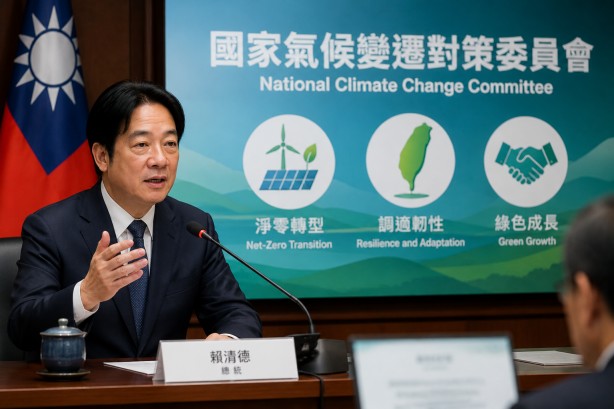
In a bid to enhance Taiwan’s climate resilience, President Lai Ching-te presided over the National Climate Change Committee’s eighth meeting, unveiling three strategic pillars: boosting social engagement, enhancing energy security, and safeguarding the nation’s land vitality. As climate risks escalate in complexity and frequency, Lai underscored the government’s focus on food security, energy autonomy, and disaster preparedness, while advocating for climate governance to transcend policy and permeate daily life and local communities.
To foster greater public involvement, the government is spearheading a nationwide urban forest initiative. This effort includes the creation of a national Urban Forest Promotion Committee and plans to host 50 local forums to collect public feedback prior to finalizing a comprehensive national urban forest strategy later in the year.
Highlighting Taiwan’s advancements in renewable energy, Lai noted the country’s impressive progress in offshore wind power, with the installation of 508 turbines generating a total capacity of 4.9 gigawatts. This achievement positions Taiwan among the top global offshore wind markets. Future initiatives will aim to further expand renewable energy sources, fortify the power grid, enhance energy storage capabilities, and build robust local supply chains, all while maintaining environmental sustainability.
President Lai also emphasized the critical need to protect Taiwan’s natural environments—forests, farmland, rivers, wetlands, coastlines, and marine ecosystems—to bolster resilience against extreme weather, flooding, sea level rise, and agricultural challenges. Integrating climate adaptation into land-use planning and agricultural policies, Taiwan aims to align its efforts with international environmental standards.
During the committee meeting, officials from various government departments, including the Ministry of Environment, Ministry of Agriculture, Ocean Affairs Council, and Ministry of Economic Affairs, presented comprehensive reports. These covered topics such as environmental education, sustainable agriculture, ecosystem conservation, and Taiwan’s long-term strategy for offshore wind development.
Legal Disclaimer: The information contained in this article has been provided by independent third-party contributors, clients, or content partners. We do not independently verify the accuracy, completeness, legality, ownership, licensing, or reliability of submitted content, including text, images, videos, trademarks, or other media materials. The submitting party is solely responsible for ensuring that all content, including images and media assets, complies with applicable copyright, trademark, licensing, and intellectual property laws. We disclaim liability for any unauthorized use of copyrighted or proprietary materials by third parties. If you believe that any content published on this platform infringes your intellectual property rights, kindly contact the author above for prompt review and resolution.