
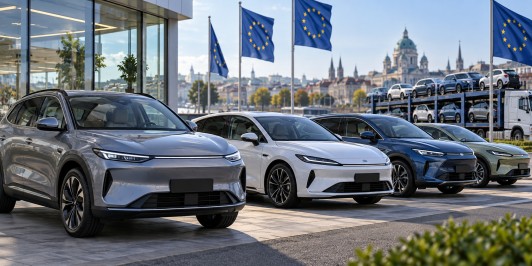
Sales of Chinese-made hybrid vehicles in the European Union have skyrocketed, prompting concerns among EU officials over the growing competition facing local car manufacturers. Recent data reveals a significant increase in Chinese hybrid vehicle imports, with fully hybrid sales jumping from 659 units in 2022 to 160,662 units in the first seven months of 2026. Similarly, Chinese-made plug-in hybrid sales rose sharply from 56,706 to 217,764 units over the same period.
This surge in sales comes in the wake of the EU’s decision in 2024 to impose anti-subsidy tariffs on Chinese electric vehicles, a measure that did not extend to hybrid cars. Consequently, Chinese hybrids have been able to capture a larger share of the European market, now representing nearly 37% of the automotive sector, compared to just over 21% for fully electric vehicles.
In response to this growing market penetration, the European Commission has approached China to voluntarily limit its export of hybrid vehicles to the region. Should these negotiations fail, the EU may consider implementing safeguard measures, potentially including export quotas, to protect its automotive industry from further competitive pressures.
Chinese automakers such as BYD, Chery, and Leapmotor have reported strong growth in the European market, with Geely leading as the largest Chinese automotive group in the region. BYD alone sold approximately 177,000 vehicles within the EU, while Geely’s sales reached about 205,000 units in the first eight months of 2026. Despite these gains, European manufacturers continue to hold the largest overall market share in the region.
The increase in Chinese vehicle imports has exacerbated the EU’s trade imbalance with China, raising concerns about the long-term competitiveness of Europe’s automotive industry. As the market dynamics continue to evolve, the EU is exploring strategies to address these challenges and maintain a balanced trade relationship with China.